
You can also download the PDF Report - Click Here
Watertown, TN
Water Quality Report 2024
Is my drinking water safe?
Yes, our water meets all of EPA’s health standards. In 2024 we have conducted testing for many contaminants that may be in drinking water. As you’ll see in the chart, we detected no contaminants.
What is the source of my water?
Your water comes from two wells that are located on Hwy 70 in the Ridley Limestone Aquifer. We’re working hard to protect our water from contaminants, and working with the State of TN to determine the vulnerability of our water supply to potential contamination. We have developed a well head protection plan that can be reviewed upon request.
The TN Dept. of Environment has prepared a Source Water Assessment Program report for untreated water sources. The report assesses the susceptibility of untreated water sources to potential contamination. To ensure safe drinking water, all public water systems treat and routinely test their water. Water sources have been rated as reasonably susceptible, moderately susceptible, or slightly susceptible based on geological factors and human activities in the vicinity of the water source. Our rating is reasonably susceptible. An explanation of the Tennessee Source Water Assessment Program, the Source Water Assessment summaries, susceptibility scorings and the overall TDEC report to EPA can be viewed at https://www.tn.gov/environment/program-areas/wr-water-resources/water-quality/source-water-assessment or you may contact the water system to obtain copies of specific assessments.
Why are there contaminants in my water?
Drinking water, including bottled water, may reasonably be expected to contain at least small amounts of some contaminants. Community water systems are required to disclose the detection of contaminants, however, bottled water companies are not required to comply with these regulations. The presence of contaminants does not necessarily indicate that water poses a health risk. More information about contaminants or potential health effects can be obtained by calling the Environmental Protection Agency’s Safe Drinking Water Hotline (800-426-4791).
The sources of drinking water (both tap water and bottled water include rivers, lakes, streams, ponds, reservoirs, springs, and wells. As water travels over the surface of the land or through the ground, it dissolves naturally-occurring minerals and in some cases, radioactive material, and picks up substances resulting from the presence of animals or from human activity. Contaminants that may be present in source water:
*Microbial contaminants, such as viruses and bacteria, which may come from sewage treatment plants, septic systems, agricultural livestock operations, and wildlife.
*Inorganic contaminants, such as salts and metals, which can be naturally-occurring or result from urban stormwater runoff, industrial, or domestic wastewater discharges, oil and gas production, mining, or farming.
*Pesticides and herbicides, which may come from a variety of sources such as agriculture, urban storm water runoff, and residential uses.
*Organic chemical contaminants, including synthetic and volatile organic chemicals, which are by-products of industrial processes and petroleum production, and can also come from gas stations, urban storm water runoff, and septic systems.
*Radioactive contaminants, which can be naturally-occurring or be the result of oil and gas production and mining activities.
In order to ensure that tap water is safe to drink, the EPA and TDEC prescribe regulations which limit the amounts of certain contaminants in water provided by public water systems. FDA regulations establish limits for contaminants in bottled water which must provide the same protection for public health.
How can I get involved?
The Watertown City Council meets at 6:00PM on the third Tuesday of every month at the Watertown Community Center. Please feel free to participate.
Is our water system meeting other rules that govern our operation?
The State and EPA requires us to test and report on our water on a regular basis to ensure its safety. We have always met all of these requirements. We want you to know that we pay attention to all the rules. Watertown Water System works diligently to provide quality water to every tap. We send two samples a month to have tested for total Coliform bacteria. The State conducts inspections (known as Sanitary Surveys) of our water system. Copies of these reports are available for review.
Do I need to take special precautions?
Some people may be more vulnerable to contaminants in drinking water than the general populations. Immuno-compromised persons such as persons with cancer undergoing chemotherapy, persons who have under-gone organ transplants, people with HIV/AIDS or other immune system disorders, some elderly, and infants can be particularly at risk from infections. These people should seek advice about their personal sanitation, food preparation, handling infants and pets, and drinking water from their health care providers. EPA/CDC guidelines on appropriate means to lessen the risk of infection by Cryptosporidium and other microbiological contaminants are available from the Safe Drinking Water Hotline (800-426-4791).
If present, elevated levels of lead can cause serious health problems, especially for pregnant women and young children. Lead in drinking water is primarily from materials and components associated with service lines and home plumbing. Watertown Water System is responsible for providing high quality drinking water, but cannot control the variety of materials used in plumbing components. When your water has been sitting for several hours, you can minimize the potential for lead exposure by flushing your tap for 30 seconds to 2 minutes before using water for drinking or cooking. If you are concerned about lead in your water, you may wish to have your water tested. Information on lead in drinking water, testing methods, and steps you can take to minimize exposure is available from the Safe Drinking Water Hotline or at https://www.epa.gov/ground-water-and-drinking-water/basic-information-about-lead-drinking-water.
To address lead in drinking water, public water systems were required to develop and maintain an inventory of service line materials by October 16, 2024. Developing an inventory and identifying the location of lead service lines is the first step for beginning lead service line replacement and protecting public health. The service line inventory may be found at https://watertowntn.com/site/wp-content/uploads/file_manager/88-20241105155232.pdf . Please contact us if you would like more information about the inventory or any lead sampling that has been done.
Copper is an essential nutrient, but some people who drink water containing copper in excess of the action level over a relatively short period of time could experience gastrointestinal distress. Some people who drink water containing copper in excess of the action level over many years could suffer liver or kidney damage. People with Wilson’s disease should consult their personal doctor.
For more information about your drinking water, please contact JC York at fertifiedwateroperators@gmail.com or City Hall at 615-237-3326.
Este informe contiene information may importante. Transduscalo o hable con algulen que lo enlenda bien.
WATER QUALITY DATA
What does this chart mean?
MCLG: Maximum Contaminant Level Goal, or the level of a contaminant in drinking water below which there is no known or expected risk to health. MCLGs allow for a margin of safety.
MCL: Maximum Contaminant Level, or the highest level of a contaminant that is allowed in drinking water. MCLs are set as close to the MCLSs as feasible using the best available treatment technology.
Discretionary language regarding the use of averages to report levels of some contaminants.
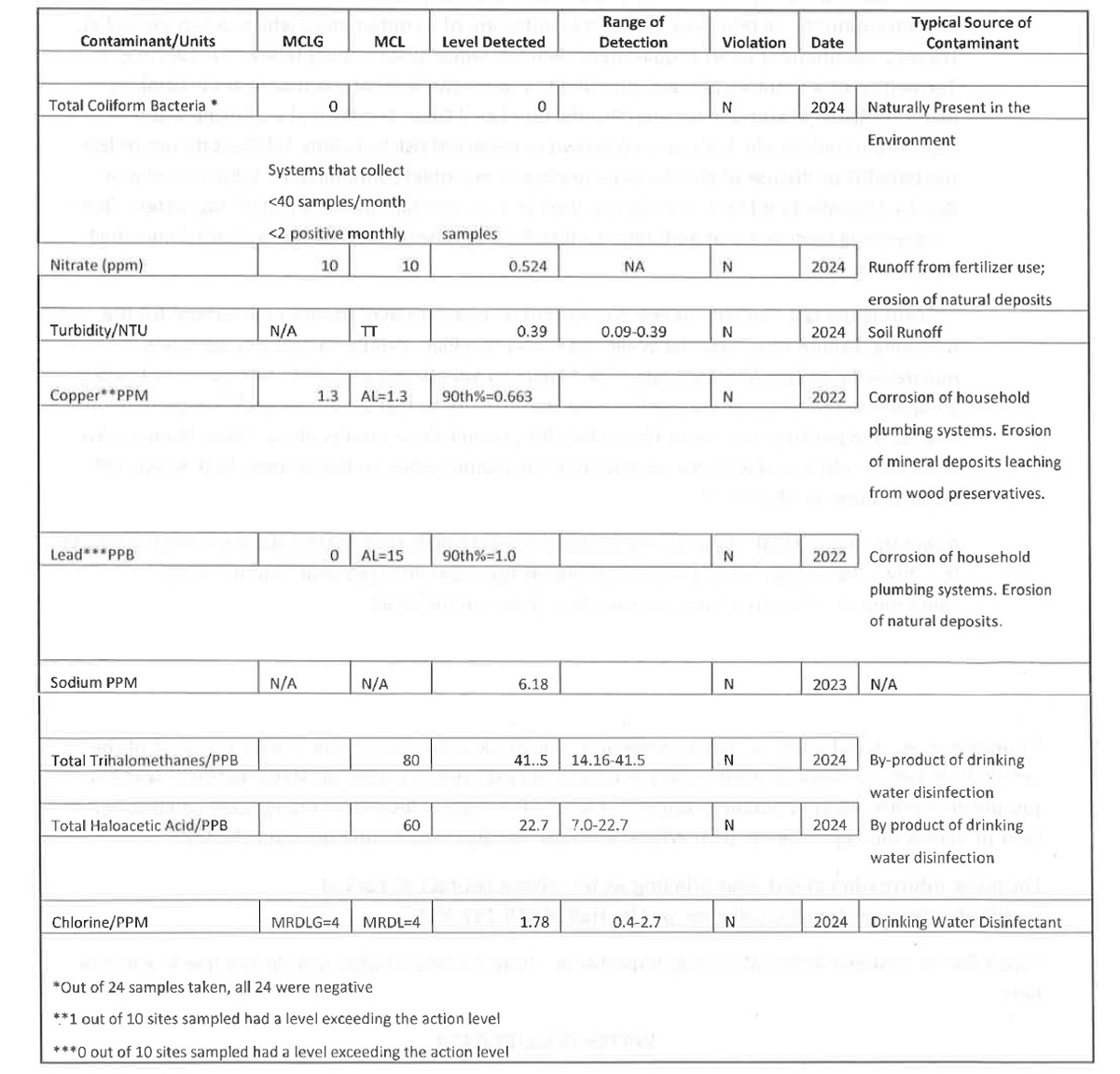
Turbidity: Turbidity does not present any risk to your health. We monitor turbidity, which is a measure of the cloudiness of water, because it is a good indicator that our filtration system is functioning properly. We met the treatment technique requirements for turbidity in 2024.
Abbreviations: PPB: parts per billion or micrograms per liter*PPM: parts per million or milligrams per liter*N/A: not applicable*NTU: Nephelometric Turbidity Unit, used to measure cloudiness in drinking water*MFL: million fibers per liter, used to measure asbestos concentration*AL: action level, or the concentration of a contaminant which, when exceeded, triggers treatment or other requirements which a water system must follow*TT: Treatment Technique, or a required process intended to reduce the level of a contaminant in drinking water*MRDLG: Maximum Residual Disinfectant Level Goal: The level of a drinking water disinfectant below which there is no known or expected risk to health. MRDLGs do not reflect the benefits of the use of disinfectants to control microbial contaminants. MRDL: Maximum Residual Disinfectant Level. The highest level of a disinfectant allowed in drinking water. There is convincing evidence that addition of a disinfectant is necessary for the control of microbial contaminants.
***During the last Sanitary Survey, the system received an NOV (notice of violation) for the following: Failure to update the Wellhead Protection Plan. Failure to perform adequate maintenance on the WWD storage tank. Failure to adequately disinfect line repairs and collect adequate bacteriological samples for new lines. Failure to test all known backflow prevention devices and perform surveys of the system for possible cross connections. These failures have since been addressed with the exception of the maintenance on the Storage Tank which will begin in summer of 2025.***
About the data: Most of the data presented in this table is from testing done between 1 Jan- 31 Dec 2024. We monitor for some contaminants less than once per year, and for those contaminants, the date of the last sample is shown in the table.
Join us around Watertown for great events!
 9/11 Memorial
Watertown Ag Pavilion
12:00PM - 01:00PM
9/11 Memorial
Watertown Ag Pavilion
12:00PM - 01:00PM
 2026 Train Robbery Excursion Trains
Train Depot & Square
2026 Train Robbery Excursion Trains
Train Depot & Square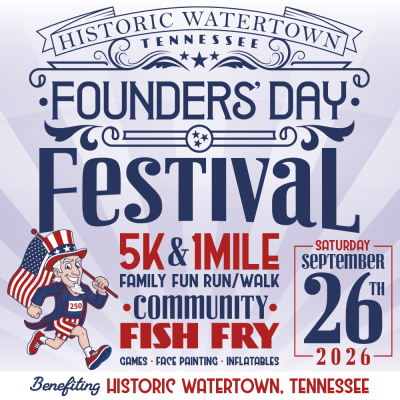 Historic Watertown - Founders Day Festival
Watertown, Tennessee
07:00AM
Historic Watertown - Founders Day Festival
Watertown, Tennessee
07:00AM
 Fall Festival - Benefiting Jake Harris Scholarship
Three Forks Community Park
01:00PM - 05:00PM
Fall Festival - Benefiting Jake Harris Scholarship
Three Forks Community Park
01:00PM - 05:00PM
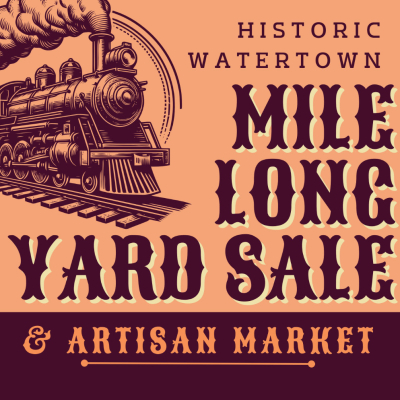 2026 Fall Mile Long Yard Sale & Artisan Market
Watertown, Tennessee
2026 Fall Mile Long Yard Sale & Artisan Market
Watertown, Tennessee